Posted earlier but my phone ate it.
HW is a serious inspiration to me. His work is one of the reasons I love working on old knives - he has great design aesthetic and tasteful execution of his vision.
For the curious about materials:
Micarta - Micarta is a trade name for Westinghouse Phenolic Composite material. It's basically a substrate (Canvas, Linen or Paper) that has been impregnated and surrounded by a phenolic resin compound and cured under heat and high pressure to form a solid material. Phenolic Formaldehyde resins were one of the first stable, synthetic materals, but it lacked structural strength. Curing it around a substrate created a material that became known as the "Steel of the plastics industry". Micarta is hard, dense, wear resistant, machinable, has limited water takeup and can be polished or left rough to afford different levels of grip. Paper micarta, with it's fine substrate, can be jigged like bone (with a little work) and take an almost mirror polish look like ivory. Overall It's a warm, rich material to work with, and has a pretty distinctive look. Because of the nature of the phenolic, the dust from grinding on micarta isn't super for you, so respirators are a good idea.
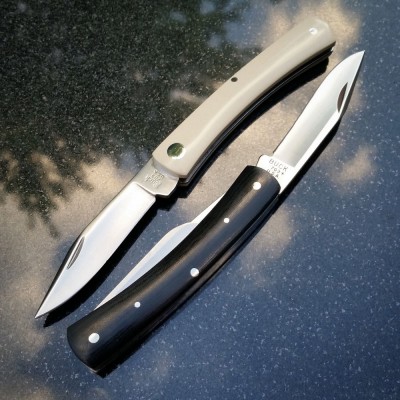
Here's a pair of Buck 703's that were redone in Ivory paper micarta, and Black Linen (notice the texture) Micarta
G10 - If Micarta is the "steel of the plastics industry" then G10 is the Titanium. It's similar in that it's a layered composite material, but G10's substrate is a fine woven glass fiber impregnated and surrounded by an epoxy material cured under high heat and pressure. It's stronger, lighter, and more rigid than Micarta. Some grades of it (FR4) are fire resistant. It's an electrical insulator, much like Micarta. If you're reading this post, you have G10 in front of you, as the Fire Resistant grade (FR4) is the "green circuit board" in your PC or phone. The epoxy material can be dyed during manufacturing to dozens of different colors. It has minimal water uptake when wet, is virtually indestructible as far as traditional handle materials go, and can be machined with reletive ease (it's tough on cutters through, because of the glass). It will polish to a gorgeous high gloss finish with a bit of work, or can be bead blasted to allow for grip. The dust from grinding on G10 is basically epoxy and glass, so nothing you ever want to breath in.
If you replaced the G (glass) in G10 with Carbon fibre substrate, you would have the knifemakers "i.e. solid block" Carbon Fiber. It's even lighter than G10, and more rigid, but slightly less resistant to impact damage (and a heck of a lot worse to work with, dust wise - both health and general crappiness)
Here's some polished G10 on a GEC from a long while ago, and some bead blasted G10 from my own 51OT rebuild not long ago
Kydex is something you will only ever see in sheaths, never handles. It's a low temperature thermoplastic, meaning it gets "floppy" like a thin, wet leather when heated, and retains it's shape when cooled down. You can hit a sheet of Kydex with a heat gun and litteraly mold it around a blade or gun to get a custom fit sheath or holster. It'll stay that way until it gets hot again (IIRC the forming temp for kydex is like 300f or something like that, but it can lose some of it's rigidity if you hit it with say, a hair dryer on high lol)


 I'm not sure how I did it but I suspect the Wild Turkey 101 had something to do with it.
