ea42 wrote:Camillus may have just made the clip blade for that batch of scrimshaws, especially if it wasn't part of the regular run but rather a large special order and they need the blades pronto.
Eric

I am a little slow on the uptake tonight. I thought we were still talking about the original 8OT.

The knives with blades, which are tang stamped with the S.C.C.+ tang stamps, were to the best of my knowledge made at the Camillus factory and some were assembled there, but not necessarily all of them.
Two examples of this are the 898UH and the 885UH; both patterns were tang stamped with the S.C.C.+ tang stamp. Below is a copy of the two S-cards, which detail the manufacturing instructions for both patterns including the tang stamp, the handle covering, blades, types of pins to be used including whether they were to be spun or not. In short it was all the details the Camillus factory workers needed to make that production run of knives according to the specifications of the customer who had ordered it. In this case the customer ordering the knives was Schrade. These knives were finished at the Camillus factory.
Now, there were 8OTs also produced completely at the Camillus factory, however they DID NOT have the S.C.C.+ tang stamp. Instead if you look at the S-card below you will see that these 8OT these were stamped on the mark side of the clip blade: written “Clip M.S.” on the card, and the tang stamp was SCHRADE/U.S.A. 8OT, as detailed in the lower right-hand box of the S-card.
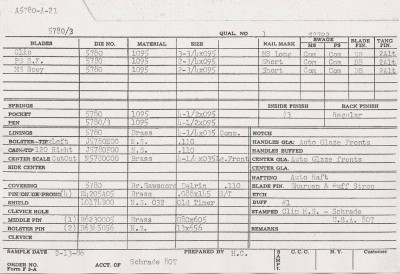
Here we have examples of knives that were completed at the Camillus factory that had the special S.C.C.+ tang stamp, and we have the 8OT, which was made entirely at the Camillus factory and did not have a special tang stamp. But if you read the card, these knives were made with through pin construction NOT Swinden construction. Look at the lower left-hand part of the card in the first column says: “BOLSTER PIN (2).” The second column gives the die number to be used, and the third column indicates the type of pins to be used: “N.S.” indicating they were nickel silver pens. These were definitely not knives made of Swinden construction, they were obviously through pin construction and they were made in 1986! This is long after we would expect to find a new through pin Old Timer on the shelf at your local knife shop. What we don’t know is where these knives went, they could have been made for export so far as we know, the card just does not tell us those details. But if you look around the card you’ll find even more information about this knife including the fact that the master blade was to be made with a long pull.
So from Camillus’ his own records we see that they made knives of through pin construction for Schrade, both with the special S.C.C.+ tang stamp and the appropriate tang stamp we would expect to find on the given pattern, in this case the 8OT.
Now, there is a third way in which Camillus helped her produce knives for Schrade and that is they would make parts for them so that Schrade could assemble the knives themselves.
In the purchase order #2367, shown below, and dated 4/17/86 we see that Schrade ordered knife blades to be made at the Camillus factory for installation in knives at the Schrade factory. They ordered 180,000 blades; 30,000 of each blade use and the 8OT and in the 34OT. This was enough blades to for 60,000 stockman knives, 30,000 of the 8OT and 30,000 of the 34OT.
Sometimes it seems like the supply of Old Timers and Uncle Henrys is nearly endless, you can still buy them NIB online. When you look at orders like these you understand why. The S-card for the 8OT is dated February 13, 1986 and then we look at the purchase order for 180,000 blades enough to make 30,000 new 8OTs and 30,000 new 34OTs and we realize it was barely two months later when that order was placed then we begin to get a little bit of an idea of how many knives were made with Schrades name on them!
Eric is absolutely correct, Camillus probably made the SCC 505 blades for the scrimshaw knives, and the reason you don’t see the through pen is that the knives were manufactured in the Schrade factory on the Swinden machinery.
At least that’s my understanding of the way it worked. Eric was a lot closer to what went on in Schrade than I was, (about 3000 miles closer). My information is all secondhand so if I am mistaken, Eric please feel free to set the record straight, with my blessing!

 KC Though a Different Pattern , A last ditch effort none the less

 Thanks KC

 I was basically asking if Camillus had the ability to manufacture any knife with the Swinden key.